
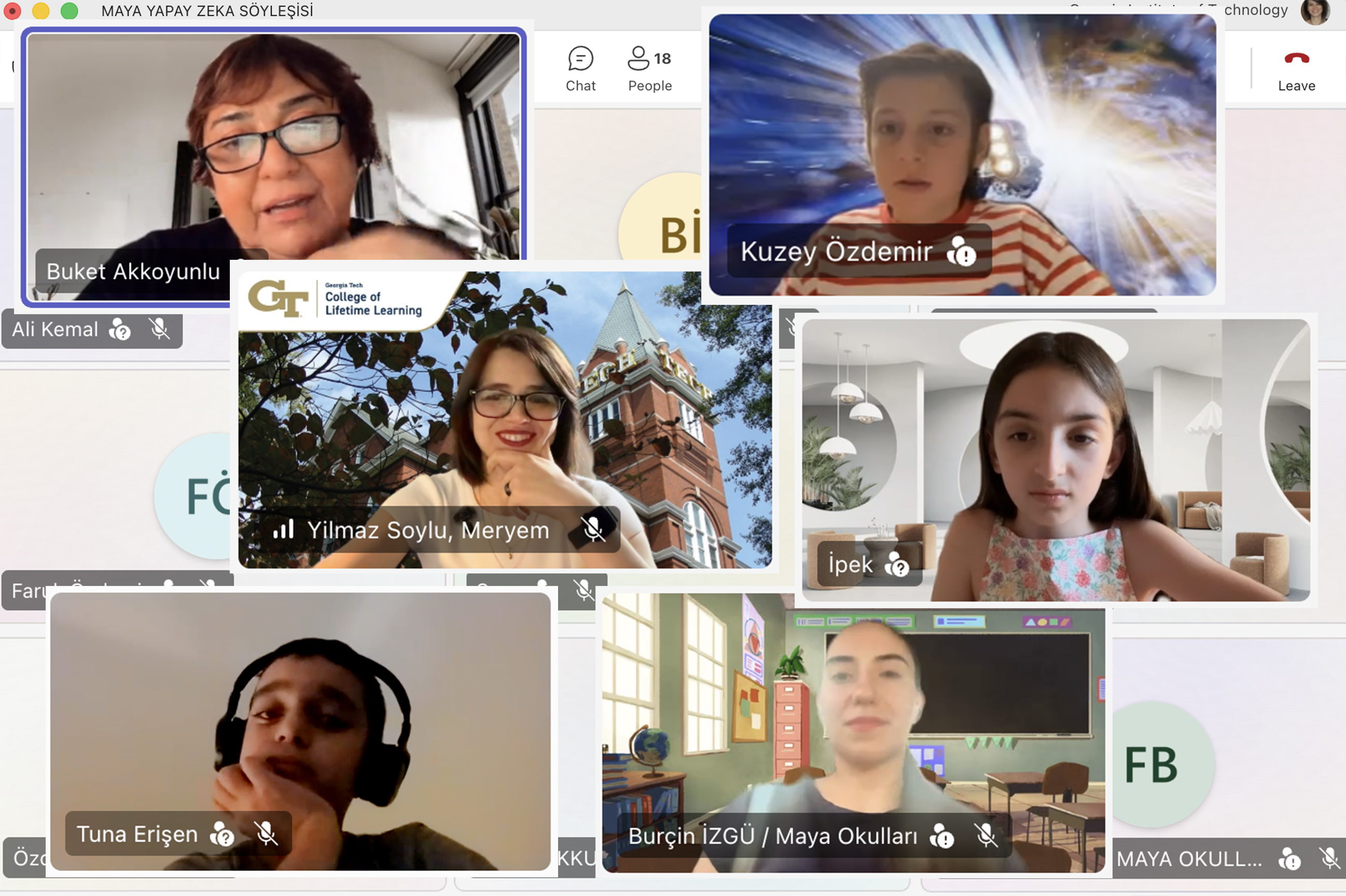
A College of Lifetime Learning researcher connected virtually with elementary school students in Türkiye to discuss artificial intelligence, lifelong learning, and the uniquely human skills that will remain essential in an AI-enabled future.
At 7 p.m. in Ankara, Türkiye, 18 fourth-grade students and their family members from Maya Schools logged into Microsoft Teams to hear a presentation from Meryem Yilmaz Soylu, a research scientist in the Georgia Tech College of Lifetime Learning, who joined them from Atlanta.
Yilmaz Soylu was excited and a little nervous to speak with 10-year-olds about artificial intelligence and the future of learning in her native language. While she has presented to Turkish school-aged children before, this was the first time she shared her current Georgia Tech research with students in her homeland and discussed it in Turkish rather than her day-to-day working language, English.
“Presenting this topic in Turkish was both interesting and deeply meaningful,” Yilmaz Soylu said. “Most of my academic and professional work now happens in English, so I am used to thinking, writing, and presenting about AI and learning in that language. Preparing this talk in Turkish made me slow down and reconsider the ideas. I was not just translating academic concepts. I was trying to make them feel familiar, concrete, and meaningful to children.”
The opportunity came through Buket Akkoyunlu, vice rector of Çankaya University in Ankara, Türkiye, and Yilmaz Soylu’s colleague, collaborator, and former professor and mentor during her graduate studies at Hacettepe University. Akkoyunlu invited her to speak with students who have been learning AI literacy, including prompt writing and responsible AI use, as part of their school curriculum. Instead of attending their typical after-school activities, the students chose to attend the presentation.
To connect with the young audience, Yilmaz Soylu shared a childhood memory of being fascinated by technology and wondering whether tiny people lived inside the radio. That curiosity eventually led her to study how people learn and how technology can support learning.
“I used the distance between Atlanta and Ankara as a concrete example of technology’s power,” she said. “Although we were about 5,960 miles apart, technology enabled us to meet and talk in real time.”
She explained that AI extends far beyond generative AI tools such as ChatGPT. Students encounter AI every day through technologies including YouTube and Spotify recommendations, Siri, Google Translate, navigation applications, medical technologies, and autonomous vehicle systems.
Yilmaz Soylu’s goal was to help students understand that while AI can be a powerful tool, people remain responsible for directing, evaluating, and using it thoughtfully. She wanted them to leave feeling hopeful rather than fearful. Rather than competing with AI, she encouraged them to learn how to use it responsibly while continuing to develop the unique human skills that technology cannot replace.
The students responded with questions that went far beyond how to use AI tools. They asked about privacy, employment, responsibility, the future of education in 2035, and the skills they may need to thrive in an AI-enabled world.
“I was particularly touched when one student connected lifelong learning to the Turkish saying ‘Öğrenmenin yaşı olmaz,’ meaning ‘Learning has no age,’” Yilmaz Soylu said. “He explained, in his own words, that learning begins but never truly ends. That response showed me the students had grasped the presentation’s deeper message: Success in the AI age will not depend solely on mastering one technology. It will depend on staying curious and willing to learn throughout life.”
Throughout the presentation, Yilmaz Soylu emphasized a simple message: “AI is the tool; you are the hero.”
The students appeared to embrace that idea, carrying away a lesson that applies to learners of every age: Technology may change, but curiosity, responsibility, and a commitment to lifelong learning remain essential.