
From global conversations to new academic programs, the College of Lifetime Learning is changing how Georgia Tech supports learners at every stage of life. With an increasing number of opportunities for students, faculty, and thought leaders to take part in, the College is expanding its impact while helping shape the future of learning.
As artificial intelligence, shifting workforce needs, and technological changes continue to reshape society, conversations about the future are taking place all around the world.
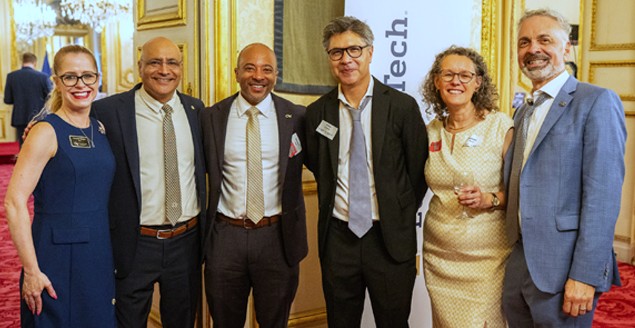
Last month, Inaugural Dean Bill Gaudelli represented the College of Lifetime Learning in Paris, France, where he participated in Tech Talks Business, a forum that brings together leaders from higher education, industry, and government. During the event, Gaudelli joined other special guests and thought leaders in discussions focusing on how universities can better prepare their learners in an increasingly AI-focused world.
“The rise of AI reminds us that learning is not a one-time event but an ongoing process of development. As technology changes, our ability to adapt, inquire, and think in new ways will grow in importance,” he said. “Building a learning society means creating opportunities for people to continue developing throughout their lives regardless of where they work or live, and it’s incumbent on higher education to provide flexible access to the knowledge we create."
Those conversations reflect a challenge that extends beyond a single event or institution. Globally, universities are rethinking how they prepare learners for careers that don’t yet exist, or that may evolve rapidly, and for a world where constant learning is the norm rather than the exception. In the 21st century, traditional models built around a degree earned early in life are giving way to more flexible pathways that encourage individuals to reskill and upskill throughout their lives.
That shift remains at the heart of the College’s mission.
Earlier this year, while speaking at Stanford University’s Century Summit, Gaudelli described the College’s vision for the expanding role of higher education beyond the traditional four-years-and-done model.
“We're really thinking about the lifespan, expanding the value promise, and I'm really excited about that,” he told attendees. “That's exactly the way universities should be thinking about it, which is how do we take this wonderful thing we call the university and extend its value both to the youngest people and to the oldest people on the planet all the time? That's what I'm really excited about — it’s kind of like a lifetime warranty on learning.”
The vision is already taking shape across the College. This fall, the Minor in Learning, its first credit-bearing academic credential, will launch with classes developed in partnership with the School of Psychology. The interdisciplinary program will explore how people learn across multiple settings while preparing students to design learning systems that respond to the changing world.
Concurrently, the College is generating research that informs both scholarship and practice. The recent addition of its first tenure-track faculty member, Seyedahmad “Ahmad” Rahimi, strengthens the College’s growing expertise in learning sciences, artificial intelligence, instructional design, and psychometrics. Additionally, a recent $10,000 grant from the Atlanta chapter of the Project Management Institute will support research examining project management trends, ensuring coursework reflects the most up-to-date needs of employers and leaders.
The College is also creating opportunities to bring together educators, researchers, employers, and policymakers. This October, the Lifetime Learning Symposium will host thought leaders from higher education and industry to discuss what it means to build a learning society and how institutions can expand access to learning for every stage of life.
Together, these initiatives represent how the College is putting its vision into practice. Whether through new academic programs, research opportunities, or candid conversations, the College is working to create opportunities for people to continue to grow.
As technology continues to transform how people work and live, the need for lifelong learning across the globe will continue to grow. By focusing on building partnerships, creating programs, and sharing ideas, the College is helping redefine what higher education can be for learners everywhere.