
Two research teams within the College of Lifetime Learning are piloting new approaches to online education that integrate artificial intelligence and immersive virtual reality with thoughtful instructional design. More than technology experiments, these projects show how the College refines learning innovations before scaling them across programs.
Research Scientists Eunhye Grace Flavin, Abeera Rehmat, and Jeonghyun (Jonna) Lee are developing an AI-assisted course titled Design of Learning Environments. The course is being piloted within the College to gather feedback and data before broader implementation.
“We want to study how AI can meaningfully support learning,” Flavin said, “and how it can deepen engagement and enhance instructional design rather than distract from it.”
Faculty and staff are contributing in two ways: some are enrolling in the course and participating in AI-supported activities and surveys, while others are reviewing instructional models and providing feedback. Insights from both groups will guide refinements before future rollout.
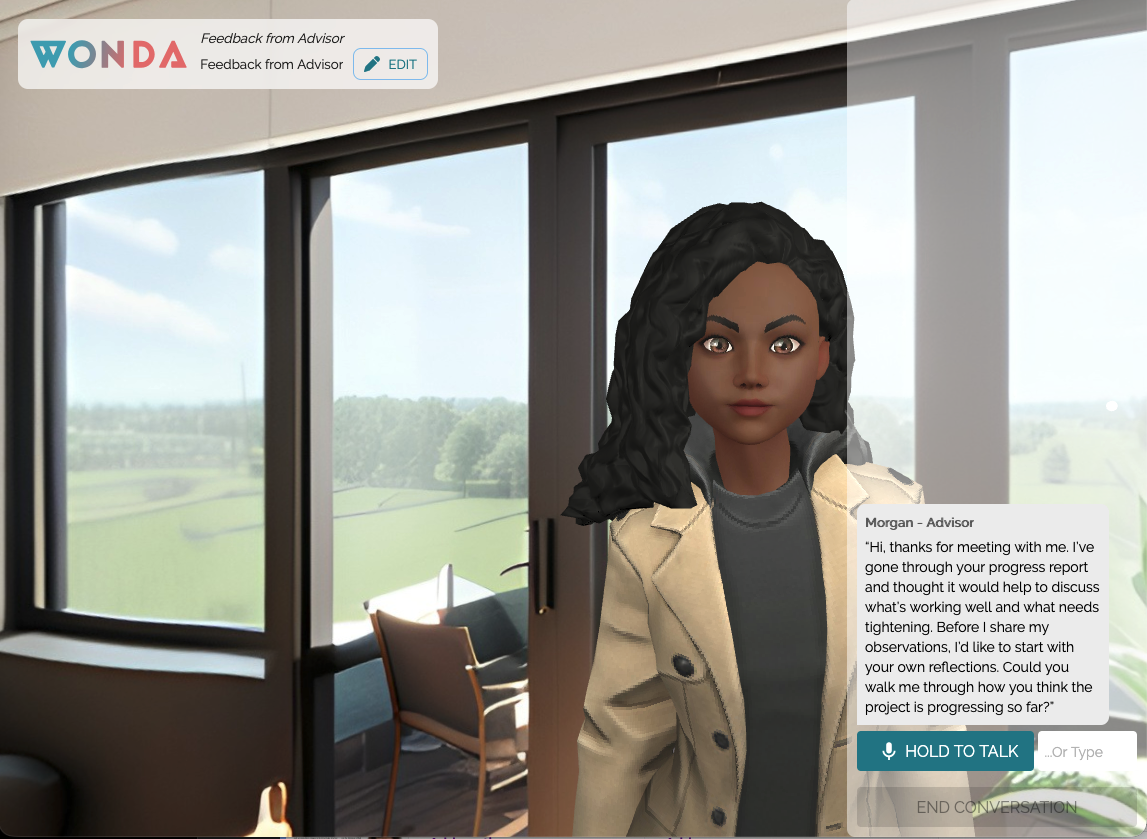
Meanwhile, Research Scientists Meryem Yılmaz Soylu and Jeonghyun (Jonna) Lee, along with Research Associate Eric Sembrat, are piloting an immersive VR module within the Online Master of Science in Analytics (OMSA) program. The module features case-based scenarios with a virtual agent, enabling students to practice leadership and workplace decision-making in realistic environments.
“Technical expertise alone is no longer enough. Our students need opportunities to practice leadership, navigate conflict, and communicate across stakeholders in realistic settings. Virtual reality allows us to create emotionally resonant, high-stakes scenarios in a safe environment where students can experiment, reflect, and grow,” Yılmaz Soylu said.
The VR experience uses branching 360° scenarios in which students’ communication choices and strategic decisions influence virtual stakeholders’ responses in real time. Insights from the pilot will inform refinements to strengthen usability, instructional alignment, and scalability before broader implementation.
“In many ways, we are building the future of online learning. We’re asking what works and what supports learning. It’s incredibly exciting to be part of a college that embraces this sort of thoughtful experimentation. Innovation like this can help us responsibly design courses for the individuals we serve,” Flavin said.
The VR module is being developed in collaboration with Lifetime Learning colleagues in instructional design, media production, and technology, as well as partners across Georgia Tech, including OMSA leadership and faculty collaborators.
Together, these initiatives reflect the College’s approach to innovation: integrating research, technology, and delivery to improve learning systems. By piloting and refining new models before scaling, the College strengthens its capacity to expand access while preserving quality and meaningful outcomes for learners across career stages.