
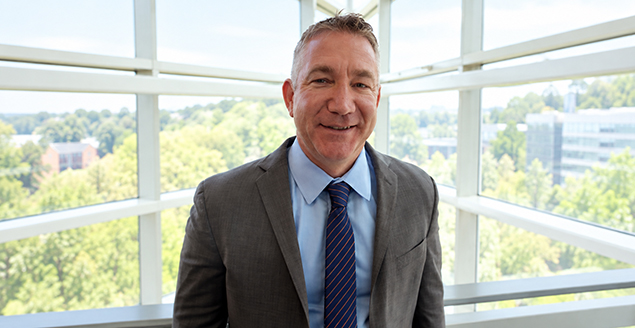
Tim Jacobbe has joined the College of Lifetime Learning as the chief catalyst for academic affairs. His career spans more than two decades in higher education, encompassing academic leadership, program innovation, assessment, and learner success.
The College of Lifetime Learning continues to build out its leadership team with the addition of Tim Jacobbe, Ph.D., as chief catalyst for academic affairs. Jacobbe’s career spans more than two decades in higher education, encompassing academic leadership, program innovation, assessment, and learner success.
“Tim’s robust and uniquely deep experience across institution types and disciplines made him stand out as the perfect candidate for this role,” said College of Lifetime Learning Dean Bill Gaudelli. “His leadership will help drive the development of innovative learning pathways that allow the College to engage learners across the lifespan on a global scale.”
Jacobbe will provide strategic leadership for degree programs, faculty affairs, academic governance, and institutional academic planning, helping build the College’s academic foundation. He will advance and oversee its academic portfolio, ensuring curriculum quality, accreditation compliance, and alignment with College and institutional priorities while strengthening learner outcomes and value.
“Tim’s leadership philosophy is grounded in relationship building, transparency, and shared governance,” Gaudelli said. “This people-centered focus, coupled with his exceptional higher education acumen, will help us expand the possibilities of what higher education can become.”
That focus on expanding access and creating opportunities for learners has been a consistent theme throughout Jacobbe’s career as an educator, researcher, and academic leader.
As a first-generation college student and U.S. Navy veteran, he has made it his mission to design and deliver innovative programs that meet learners’ needs while understanding the realities they face. His work has centered on helping learners navigate barriers and achieve their goals.
“I am excited to be part of an innovative college that wants to reimagine the role higher education can play in serving the community, industries, workforce, as well as new audiences that have not yet been considered,” he said. “Breaking down traditional boundaries and approaching things with a mindset of 'What if?' or 'Why not?' will allow us to deliver solutions and opportunities to in new ways to expanded audience, including those who may have been traditionally unserved or underserved.”
Jaccobe has put that philosophy into practice throughout his work. Early in his career, Jacobbe served as the inaugural director of a newly created education sciences major, a non-teacher education program focused on adult learners that became the second most popular major on campus. More recently as a dean, he led the development and launch of a non-credit alternative teacher certification program in partnership with 23 school districts, creating a new pathway into the teaching profession.
Jacobbe’s commitment to access shapes how he approaches emerging technologies such as artificial intelligence. He sees AI as another way for learners to create more personalized and meaningful learning opportunities. He recently developed and trained an AI system to support educators implementing a curriculum focused on statistics and computer coding for the first time.
For this new catalyst, that intersection of access, innovation, and relevance is critical to building a learning society: creating a model of higher education that meets people where they are and serves them throughout their lives.
“It is an honor to be part of a team of individuals that dream big and do not shy away from thinking differently,” Jacobbe said. “This spirit, situated in a context of such an innovative institution, has the potential to redefine what access to higher education can look like.”
Author: Joëlle Walls